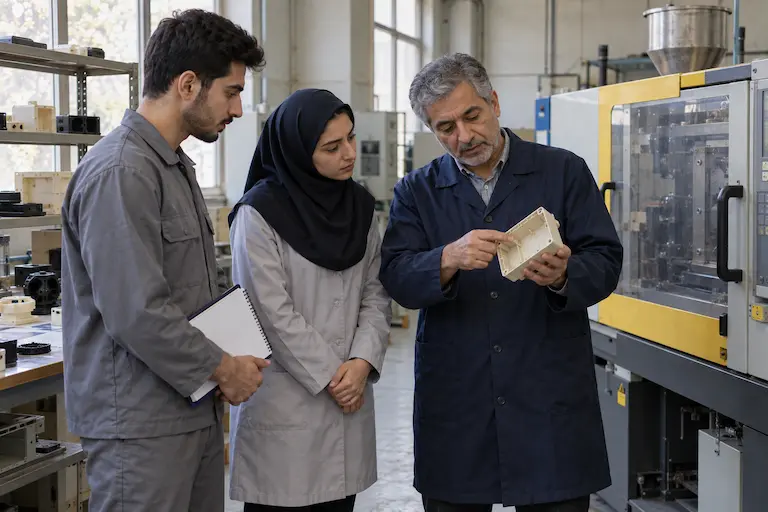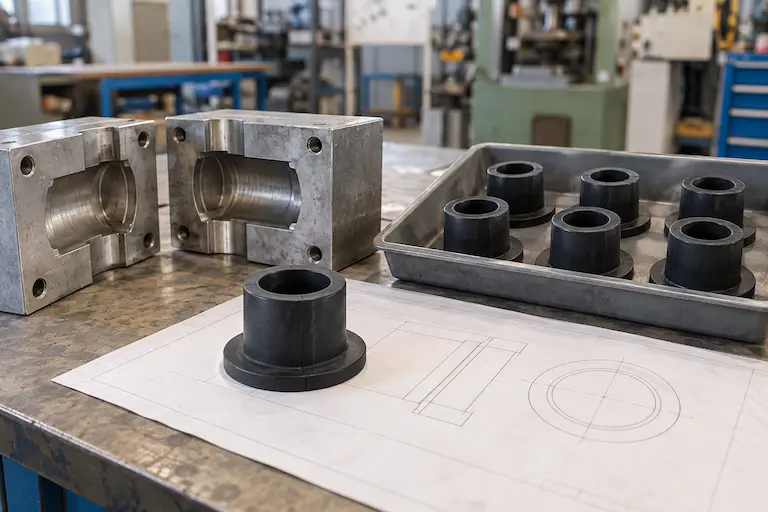
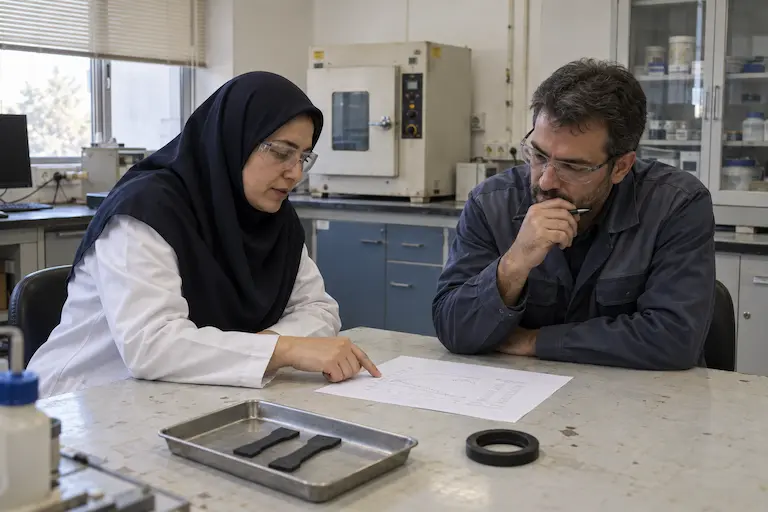
For an industrial business, university collaboration becomes meaningful when it helps clarify a problem and identify a suitable way to address it. A production manager may be concerned about recurring component failures, inconsistent quality or a process limitation. For a researcher, that concern needs to become a clearly defined question that can be investigated through data, analysis and testing.
CAPIS, the research centre for advanced polymer technologies, was established through a collaboration between Islamic Azad University, Najafabad, and Vulkan Industrial Group. At CAPIS, connecting industrial needs with scientific capabilities forms the basis of collaboration. This approach is intended to begin with problem definition and explore a path towards a solution that can be used in industry.
Starting with a Clearly Defined Industrial Problem
Describing a difficulty does not necessarily define the problem precisely. For example, saying that a component has a short service life does not, by itself, establish what needs to be investigated. Operating conditions, the nature of the failure, service history and the operator’s expectations all help clarify the issue.
This is a general illustration of the importance of problem definition, rather than a reference to a specific CAPIS project. The central point is that choosing a solution should follow a shared understanding of the problem, its constraints and the intended outcome.
From the perspective of the Vice-President for Research and Technology at Islamic Azad University, Najafabad, translating industrial needs into questions suitable for scientific investigation is a key aspect of collaboration. Industry describes a challenge in terms of production and operation, while the university needs to help turn it into a question that can be researched and analysed.
What Do Industry and the University Contribute?
Industry’s contribution to this collaboration extends beyond funding. Manufacturing experience, operational data, knowledge of practical constraints and access to real working environments are all part of that contribution. The university brings specialist knowledge, research methods, analytical capabilities and the expertise of academics and researchers.
In establishing CAPIS, Vulkan Industrial Group funded the creation and equipping of the centre and provided its industrial setting. Islamic Azad University, Najafabad, formed the academic and research side of the collaboration.
The value of this division of roles lies in combining two kinds of understanding: knowledge of what happens in production and knowledge of the methods that can help explain, investigate and address a problem. Industrial data without sufficient analysis, and academic analysis without an understanding of operating conditions, can each provide an incomplete picture.
Does Every Industrial Challenge Require New Research?
One principle outlined in the CAPIS model is the need to match the approach to the problem. Hamidreza Nasri, a member of the centre’s Strategic Council, has emphasised that a new research project is not automatically the appropriate response to every challenge.
Depending on the circumstances, a suitable route may involve using existing technology, adapting it to production requirements, transferring technology, working with a specialist organisation or undertaking research and development.
The initial question is therefore broader than which research project to undertake. It is also necessary to establish which route best addresses the industrial need. Research is one tool for solving a problem, and its selection should reflect the nature of the challenge and the gap between the current situation and a workable solution.
CAPIS’s Role in Coordinating Specialist Capabilities
The presence of universities, laboratories, specialists and industrial businesses does not automatically create effective collaboration. Joint work requires clarity about the expertise needed, each party’s responsibilities and how their activities contribute to a shared objective.
Under its stated development model, CAPIS intends to organise scientific, industrial and technological capabilities around particular problems. This approach relies on a collaborative network, meaning that the centre does not necessarily need to own every facility or laboratory, or employ every specialist involved.
Islamic Azad University, Najafabad, and Vulkan Industrial Group provide the initial foundation for this collaboration. Expanding connections with other universities, specialists and technology organisations is also part of the centre’s development direction.
Agreeing Responsibilities and Information Arrangements
Research collaboration in an industrial setting involves questions of time, cost, access to information and the use of results. Clarifying these matters helps the participants establish a shared understanding of the scope of their work.
Confidentiality, intellectual property and the parties’ respective contributions are important considerations. These need to be examined and agreed for each project, particularly when production data, technical know-how or proprietary business information forms part of the research.
Clear responsibilities are part of designing the collaboration. They help establish what information is required, who can access it and the basis on which results may be used or published.
How Should the Results Be Assessed?
In the approach outlined for CAPIS, the assessment of a collaboration should return to the problem defined at the outset. If the objective is to improve the performance of a component or process, research outputs need to be evaluated against that objective.
Service life, reliability, production downtime and lifecycle cost are among the measures identified for consideration when assessing impact. The choice of a suitable measure, and the ability to measure it, depend on the nature of each project.
These are proposed criteria for evaluating outcomes. Their inclusion does not mean that a particular CAPIS project has already extended service life, reduced costs or resolved a failure. Reporting such achievements requires data and evidence from the project concerned.
Preparing for an Initial Discussion
To prepare for an initial discussion, it helps to describe the problem in a few clear sentences: where it occurs, how it affects production or quality, what has already been tried and what improvement is sought.
This initial description need not include formulations, proprietary drawings or other confidential details. The information required and the arrangements for sharing it can be clarified as the potential collaboration is explored.
The starting point is a shared understanding of the need. This provides a basis for considering the expertise required and the most suitable route for investigating the challenge.